How Camera Creators Can Build an Audience Beyond Their Own Channels
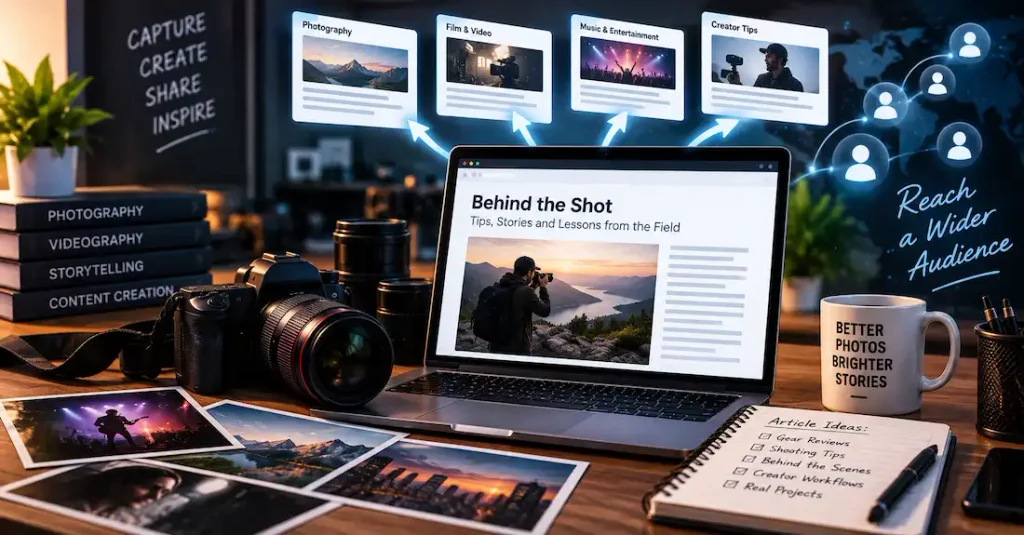
A strong photograph or video can travel far beyond the account where it first appears, but discovery rarely happens by itself. For camera enthusiasts, working photographers and video creators, contributing useful stories to other publications can introduce their work to readers who already care about entertainment, visual culture or production. The goal is not simply to place a link: it is to share something worth reading and give people a reason to explore more of your work.
Start with a story, not a placement
Before looking for a publication, decide what you can explain especially well. A camera review is one possibility, but many readers are better served by practical experience: how you prepare for a low-light concert, choose lenses for a small venue, record clean audio on location, or organize files after a long shoot. A specific lesson from a real project is more useful than a broad article about why photography matters.
Consider the audience outside your own niche, too. A filmmaker may be interested in a story about building a visual mood on a limited budget; a musician might want to know what makes performance footage feel energetic; an entertainment writer may appreciate a clear guide to the images that help promote an independent release. Tailor the topic to the publication rather than sending the same pitch everywhere.
Find relevant publications
Search for blogs and websites that publish entertainment, film, music, photography or creator-focused material. A directory of entertainment guest posting websites and blogs can help you identify places to investigate, but treat any list as a starting point, not an endorsement. Read recent articles and check whether the site is active, whether its coverage fits your expertise, and whether its writing is aimed at real readers.
Look at the details before pitching. Does the publication accept outside contributors? What length and format does it prefer? Does it publish tutorials, interviews, opinion pieces or personal accounts? Check whether images are part of its editorial approach and how contributors should provide them. A site that regularly publishes visual stories may be a better match for a photographer than a general entertainment blog, even if both cover similar subjects.
Make the pitch easy to assess
A concise pitch respects an editor’s time. Introduce yourself in a sentence, describe the proposed article in a few lines, and explain what readers will learn. Mention relevant experience without turning the message into a résumé. If the piece depends on original photos or video stills, say what you can supply and whether you have permission to use the material.
Offer a clear angle rather than a vague topic. “A guide to concert photography” is broad; “How to keep stage lights from washing out performers in small venues” gives an editor a better sense of the article. You can also suggest a few possible headlines, but avoid presenting the pitch as a finished assignment unless the publication requests a complete draft.
Follow submission instructions carefully, and keep track of where and when you have pitched. If you do not hear back, one polite follow-up after a reasonable interval is usually enough. Editors work to different schedules, and silence is not a reason to send repeated messages or submit the same article to multiple sites at once without permission.
Prepare images and supporting material
Visual work deserves the same care as the writing around it. Select a small group of images that directly support the story, use accurate captions, and make sure you can grant the publication the rights it needs. Do not assume that a striking image is appropriate simply because it is available online. For portraits, private events or commercial work, consider whether you have the necessary permission to publish.
Technical preparation matters as well. Follow the editor’s requirements for file dimensions, format and naming. Keep original high-resolution files, but send only what is requested. Include useful information such as the camera or lens used when it adds context; equipment details should help explain a result, not distract from it.
Use outside help selectively
Some creators handle every part of a contribution themselves. Others may need help with editing, layout, captions, short-form video or graphics, especially when a shoot and a deadline overlap. A freelance marketplace such as Osdire lets buyers hire specialists across areas including writing, design, photography and video. Its flat pricing and payment held until work is approved can make the terms clearer, though it is still sensible to agree on deliverables and revisions before work begins.
Outsourcing should support your point of view, not replace it. Give collaborators a clear brief, provide the source material they need, and review the final work for accuracy and consistency. If you are hiring an editor, for instance, explain the intended audience and tone rather than asking only for a generic polish.
Build a repeatable practice
One published contribution may bring a few new readers; a steady habit can build a more durable reputation. Keep notes on questions people ask you during shoots, save lessons learned from challenging assignments, and turn those observations into possible article ideas. After publication, share the piece with the people who would genuinely find it useful, and thank the editor for the opportunity.
Measure success by more than immediate traffic. A thoughtful article can sharpen your own explanation of a technique, lead to professional conversations, or help readers understand the care behind a finished image. When the subject is specific, the publication is a natural fit and the advice is genuinely practical, contributing becomes an extension of the creative work—not just another promotion task.